Brendan O'Carroll: The Hilarious Heart of Mrs. Brown's Boys
Discover Brendan O'Carroll’s journey from Dublin to global fame as Mrs Brown. Explore his career, comedy style, and success story.

Suggested:
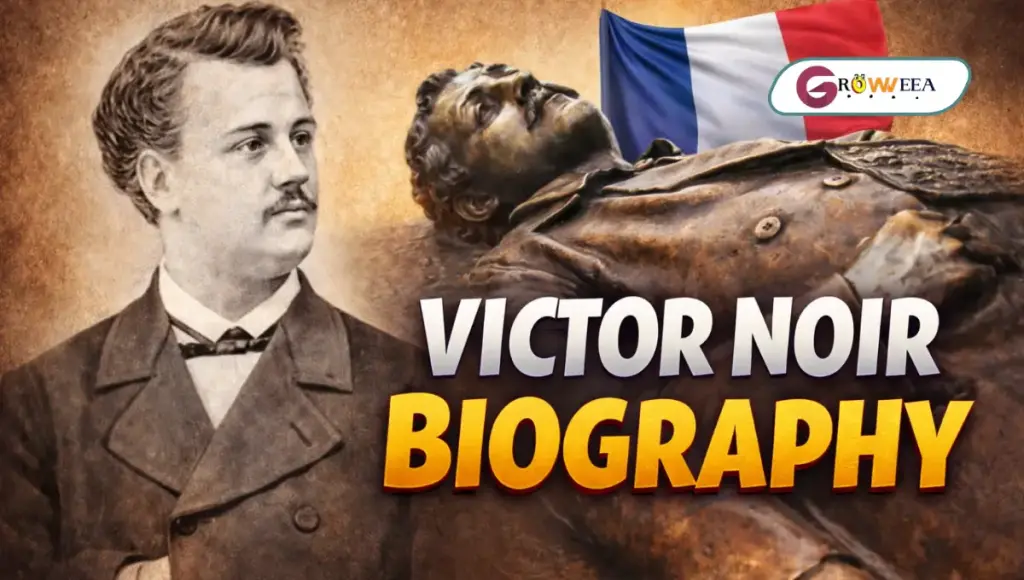
Learn about Victor Noir, the 19th-century French journalist whose shocking death sparked political outrage. Discover his biography, the famous statue at Père Lachaise Cemetery, and the unusual fertility legend surrounding it.
Victor Noir, the real name of Yvan Salmon, is one of the most mysterious figures in 19th-century France, a young journalist whose premature death sparked political outrage and left a lasting cultural legend. Noir was killed, at the age of 21, by Prince Pierre Bonaparte, the cousin of Napoleon III, as a symbol of republicanism against the corruption of the imperial system. His bronze Victor Noir sculpture at Pere Lachaise Cemetery attracts millions of people each year, not necessarily because of any political motive, but because of a weird fertility myth surrounding his provocative sculpture. This biography reveals his short life, dramatic murder, huge funeral, and his posthumous glory as a revolutionary icon.
Table of contents [Show]
Victor Noir was born on July 27, 1848, in Attigny, Vosges, a small commune of the Grand Est region of northeastern France. Noir was born in a humble Jewish family with a cobbler father named Salmon, and he was raised in the post-revolutionary tension after the uprisings in the year 1848, which gave birth to the Second Republic in France. There is very little primary data regarding his childhood, and the family lineage goes down to the Salmon line with no significant wealth or connections.
Noir immigrated to Paris as a teenager in search of opportunity and changed his journalistic pseudonym to Victor Noir in 1867. Paris of the sixties of the nineteenth century was vibrating to the modernization of Napoleon III, the boulevards of Haussmann changed the layout of the capital, and the press censorship repressed the protest. Noir, a leftist and ambitious man, had plunged into the world of radicalism, which bore the marks of the republicanism of his upbringing in the Vosges. He became one of the young minds questioning the imperial rule by the age of 20.
Attribute | Details |
|---|---|
Real Name | Yvan Salmon |
Pen Name | Victor Noir |
Profession | Journalist |
Famous As | Political martyr killed by Prince Pierre Bonaparte; Victor Noir statue fertility symbol at Père Lachaise Cemetery |
Date of Birth | 27 July 1848 |
Place of Birth | Attigny, Vosges, France |
Nationality | French |
Ethnicity/Religion | Jewish family (father converted to Catholicism) |
Family Background | Son of a Jewish cobbler |
Marital Status | Unmarried |
Children | None |
Reputation | Charismatic Parisian bohemian, principled radical |
Victor Noir was killed on January 11, 1870 (some say January 10), at 59 Rue d'Auteuil, in the Auteuil quarter, Paris. Noir was 5'9" (175 cm) with a slender, athletic physique typical of young men of his time and handsome features which would be romanticized later in life: dark hair, an olive complexion that could have been caused by any Sephardic ancestry, and a handsome face that would later give rise to romanticised portrayals. Modern sources related him as a charismatic and well-dressed person, who gained a reputation as a playboy among the Parisian bohemians. He had no children or spouse to be left after his death, and this served to keep his image that of an ever-youthful person.
Date of Death | January 10/11, 1870 (age 21) |
Place of Death | Paris, France (Rue d'Auteuil) |
Cause of Death | Shot by Prince Pierre Napoleon Bonaparte |
The professional rise of Noir started in 1868 when he got employed in La Marseillaise, a violent republican newspaper that was edited by Paschal Grousset. Noir used radical leadership to write scathing articles under the Bonaparte regime, under the leadership of Grousset, based on press freedom and imperial nepotism. His Jewish identity was hidden under his pseudonym during the antisemitic society, and his pseudonym could afford to write critiques that were more direct on the authoritarianism of Napoleon III.
The politics in France were spicy in the 1860s, there was Mexico debacle, economic crises, and the rise of republicanism, which was threatening the Second Empire. The work of Noir focused on the exuberances of the Bonaparte family, such as Prince Pierre Napoleon Bonaparte, the grandson of Napoleon I, a left-wing extremist who had a volatile personality in opposition to imperial loyalists. In December 1869, a row led to a dispute over the legacy of Napoleon I, Grousset took an anti-Bonaparte position, which led Pierre to duel, placing Noir in deadly talks.
| Details | Information |
|---|---|
Education | Not formally documented; self-taught journalist |
Career Start | Apprentice journalist in Paris, 1868 |
Key Publication | La Marseillaise (republican newspaper edited by Paschal Grousset) |
Political Stance | Republican opponent of Napoleon III's Second Empire |
Key Event | Sent as second to arrange a duel between Grousset and Prince Pierre Bonaparte |
Assassination Details | Shot during confrontation at the prince's residence; single chest wound |
Trial Outcome | Prince acquitted (self-defense claim, March 1870) |
Reinterment | 1891, Père Lachaise Cemetery, Paris (Division 92) |
Victor Noir Grave | Bronze statue by Jules Dalou depicting a death pose |
Victor Noir Statue | Hyper-realistic; features bulge, sparking fertility superstition |
Fertility Legend | Women rub the statue's groin for luck in love/pregnancy; polished from constant touching |
Cultural Impact | Symbol of press freedom; top Père Lachaise attraction |
Political Legacy | Sparked republican unrest, contributing to the Second Empire's fall (1870) |
Noir and fellow collaborator, Ulrich de Fonvillet, went to Prince Pierre Bonaparte on January 10, 1870, at his residence in Auteuil to discuss the duel terms of Grousset. Miscommunications: Pierre alleged that he was first slapped by Noir, which is why he had to use his revolver in self-defense. The allies of Noir demanded that the prince be shot without provocation when they were exchanging heated words. One shot into the chest killed Noir on the spot, he passed away on his way to medical attention.
Pierre gave up the fight, but the assassination shocked Paris. In 1870, he was acquitted by trial on the High Court in Tours (March) based on self-defense, although Fonvielle. There was evidence, such as the testimony of witnesses, that was in favor of nobility, which was causing biased allegations.
The funeral of Noir on January 12, 1870, at Neuilly Cemetery was an Inferno of the Second Empire. More than 100,000 protestors, among them Auguste Blanqui, an activist, paraded across the streets of Paris, shouting anti-imperial slogans. Barricades were erected, the police fought against crowds throwing stones. Noir, the martyr of Bonaparte's privilege, was glorified by republicans, whose funeral followed in the footsteps of revolutionary marches.
The acquittal sentence was a bombshell: the riots shook Paris, and the press protested against noble impunity. The death of Noir hastened the fall of the Empire six months later, and defeat in the Franco-Prussian Wars gave rise to the Third Republic (September 4, 1870). In 1891, his body was removed to the great cemetery of Père Lachaise in Paris ( Division 92 ), establishing martyrdom.
The real immortality of Victor Noir is based on Victor Noir's grave and the Victor Noir monument by sculptor Jules Dalou (1891). The hyper-realistic bronze is that of him after the shooting: lying on his back, top hat by head, a new hole in his forehead, death-agony contortion. Most infamously, extreme crotch protrusion - potentially either unintended cast or deliberate symbolism - generated a fertility myth.
Women started rubbing the protrusion to achieve luck with conception, the sheen obtained, and lipsticks testify to the permanence of the rituals. Visitors every year come to have the phallic blessing of Noir, and legends guarantee a pregnant woman, a lover, or a virile person. Dalou refused to admit an erotic motive, but the pose of the statue refers to a fallen hero. Efforts to vandalize have not slowed down pilgrims.
Noir was a symbol of press freedom battles politically. His funeral was used by the Third Republic as an electoral rhetoric (He marched with Victor Noir). His grave is the leading tourist attraction in Père Lachaise in Paris, along with Jim Morrison and Oscar Wilde, who is no longer a journalist, but only a bizarre eroticism.
Key Legacy Milestones | Details |
|---|---|
Initial Burial | Neuilly Cemetery, 1870 |
Reinterment | Père Lachaise, 1891 |
Statue Artist | Jules Dalou |
Fertility Ritual | Rubbing a bulge for luck (1890s-present) |
Visitor Impact | Polished groin; frequent repairs |
No known lovers, no marriage, Noir was a rake of Parisian society of the 1860s who spent his time in cafes, theaters, and radical salons. The Jewish background was never spoken of in the business world, the Playboy was a result of charms rather than scandals. Friends remembered passionate, idealistic young men who were committed to the ideals of journalism. There is no wide extant writing; parts are in the archives of La Marseillaise. His canonization after death as the innocent martyr overshadows his actual life.
Victor Noir is not an ordinary journalist, as a 21-year-old man died, triggering imperial destruction as he gave birth to a fertility cult in Victor Noir's grave. His story traces the transformations of 19th-century France, which led the son of an Attigny cobbler to become the sex symbol of Victor Noir: battles with the press, impunity of nobility, and the victory of the republic. Pere Lachaise pilgrims, 150 years later, do not read his articles, and play with bronze with babies- irony of political pyrotechnics.
Q1. What is Victor Noir height?
Ans. His height was 5 feet 9 inches.
Q2. Who was Victor Noir wife?
Ans. No official news or report about his wife has been revealed on the internet.
Q3. Where is Victor Noir grave?
Ans. The grave of Victor Noir, in the cemetery of Père Lachaise in Paris (Division 92), is a well-known grave, in bronze, which was made by Jules Dalou in memory of the French journalist.
Q4. Mention Victor Noir movie?
Ans. Vide Noir is a movie that is completely dedicated to his life, which was released in 2022.

Discover Brendan O'Carroll’s journey from Dublin to global fame as Mrs Brown. Explore his career, comedy style, and success story.
Discover Merlin Santana’s life, career, family, and tragic death at 26. Explore his rise in 90s TV, The Steve Harvey Show role, and lasting legacy.
Explore Wes Borland biography, age, band Limp Bizkit, career, net worth, and unique style in this quick guide.