
Fan art has always lived in a grey area that mostly nobody enforces.
Somebody draws a character from a show they love, posts it, the fandom shares it, and the studio either ignores it or quietly benefits from the attention. That arrangement has held for decades because the volume was limited by how long it takes to draw something.
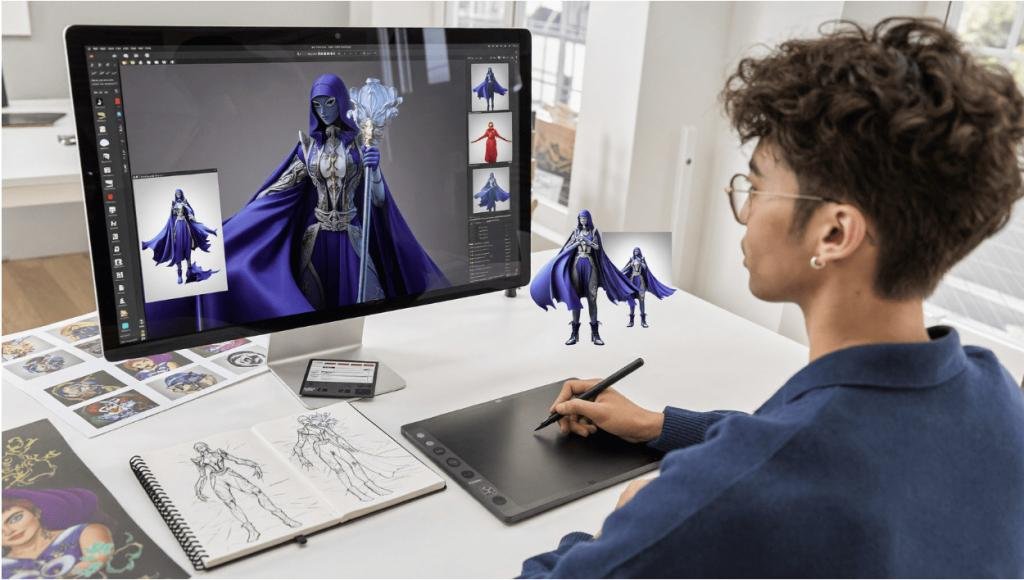
That constraint is gone. An AI Image Generator produces in seconds what used to take an afternoon, and the volume has risen accordingly. Higgsfield gives creators a faster way to develop and experiment with visual concepts, making it easier to produce more content in less time.
Which has pushed the grey area into sharper focus, and has made one distinction considerably more important than it used to be.
The distinction is between a character and a person. Those are two different legal situations and most fans treat them as one.
Table of contents [Show]
- What is the difference between a character and a person?
- Why is the entertainment industry sensitive about this?
- What should never be produced?
- Where does fan art remain reasonably safe?
- Does this apply to cosplay and photography too?
- What about original characters and worlds?
- Does posting location change anything?
- How do fandoms themselves feel about it?
- How should generated fan work be labelled?
- What does this mean for artists in these communities?
- What would a sensible approach look like?
- FAQ's
- Conclusion
What is the difference between a character and a person?
A character is intellectual property owned by a company. A person owns themselves.
That sounds obvious and it changes everything about what is permissible.
Characters are protected by copyright and frequently by trademark. The rights sit with a studio, a publisher or a production company, and those rights cover reproduction and derivative works.
Real people have rights in their own likeness, which vary considerably by jurisdiction but generally cover commercial use of their image and name.
The practical consequences:
- Fan art of a character is a copyright question, usually tolerated at non-commercial scale
- Fan art of a real person is a likeness question, and tolerance is considerably lower
- Selling either moves the situation from tolerated to actionable
- Realistic depictions of real people sit in the most sensitive category of all
Actors, musicians and idols are real people playing characters. Drawing the character is one situation. Producing a photorealistic image of the performer is another entirely.
Why is the entertainment industry sensitive about this?
Because likeness is a licensed commercial asset, and in some industries it is the primary one.
A performer's image is contracted, scheduled and monetised. Endorsements are negotiated, appearances are controlled, and the management company treats unauthorised use as a commercial problem rather than a flattering one.
Korean entertainment companies in particular are known for being active on this, with dedicated teams monitoring unauthorised use and regular action against accounts producing or selling unlicensed material.
What tends to attract attention:
- Realistic images that could be mistaken for photographs
- Anything commercial, including merchandise, commissions and monetised accounts
- Images in situations the person was never in
- Anything suggestive or intimate, which is treated far more seriously
- Material that could damage reputation or imply endorsement
The more something looks like a photograph of a real person, the more exposure it carries. That is the single most useful rule of thumb available.
What should never be produced?
A realistic image of a real person doing something they did not do. No exceptions worth entertaining.
- Never point an AI Image Generator at a performer, idol or public figure for a photorealistic image
- Never place a real person in a situation, location or event they were not in
- Never produce anything intimate or suggestive involving a real person, which is both harmful and in many jurisdictions now explicitly illegal
- Never imply an endorsement or relationship that does not exist
- Never produce an AI Image Generator image that could be mistaken for a photograph and circulated as one
That last point matters more than fans realise. An image produced as obvious fan art and reshared without context becomes a claim about something that happened, and the person in it has no way to stop it travelling.
Several jurisdictions have introduced or are introducing legislation specifically covering AI Image Generator images of real people, with the strongest provisions around intimate imagery. The direction is uniformly toward more restriction.
Where does fan art remain reasonably safe?
In the territory it has always occupied, with some care about how it looks.
- Characters rather than performers, which keeps it a copyright question
- Stylised rather than photorealistic, which signals clearly that it is art
- Non-commercial, meaning not sold, not behind a paywall, not on monetised merchandise
- Clearly labelled as fan work, which removes ambiguity
- Transformative, meaning it does something rather than reproducing an existing image
An AI Image Generator can work within all of that. The output being produced rather than drawn does not change the underlying position, though it does affect how some communities respond, which is a separate matter covered below.
What changes the situation immediately is money. The moment fan work is sold, every rights holder's tolerance drops sharply and the legal position becomes considerably clearer.
Does this apply to cosplay and photography too?
It does, and cosplayers hit a version of the same problem from the other direction.
A cosplayer photographed in character is a real person depicting a copyrighted character. That has always sat in the same tolerated grey area, and it has worked because the person in the costume is genuinely there.
What changes with generated imagery:
- Never generate a cosplayer or produce an image resembling a specific person's costume work
- Never use a cosplayer's photograph as reference input without asking
- Never pass off generated work as a photograph of a real cosplay
- Credit the photographer as well as the cosplayer, since those are two different creators
Cosplay photography is a working industry for a lot of people, and the images circulating are somebody's portfolio. Taking one as a reference without permission is a different thing from admiring it.
An AI Image Generator has a legitimate place here in costume design rather than in depicting people. Visualising a build before committing fabric and money is genuinely useful, and nobody's likeness is involved.
Keeping those design explorations in Higgsfield alongside your reference photographs makes the build process considerably easier to follow, particularly for anything complex.
What about original characters and worlds?
Entirely clear, and it is where most of the interesting work happens anyway.
An original character you invented belongs to you. There is no rights holder, no likeness question and no fandom norm to navigate.
What an AI Image Generator genuinely enables for original work:
- Visualising a character in an AI Image Generator that you have written but never drawn
- Exploring AI Image Generator variations on a design before committing
- Building a world with consistent AI Image Generator language across pieces
- AI Image Generator reference material for your own drawing
- AI Image Generator cover and promotional images for original fiction
For anybody writing fan fiction with original characters, or building an original story, this is where the technology does something genuinely useful rather than borrowing from somebody else.
It is also more interesting. Everybody has seen the popular characters rendered a thousand ways. Nobody has seen yours.
Does posting location change anything?
Considerably, since platforms have their own rules on top of the law.
Most major platforms now have policies covering synthetic media, and several apply labels automatically where provenance information is present.
What varies by platform:
- Labelling requirements, which some enforce and others request
- Policies on real people, which are generally stricter than the law
- Commercial restrictions, particularly on marketplaces
- Takedown responsiveness, which is fastest where rights holders have established relationships
Marketplaces deserve particular attention. Selling fan merchandise of any kind has always been the riskiest version, and platforms acting on rights holder complaints generally do so without investigating first.
An account removed for one infringing listing can lose everything else with it, which is the version that costs people real money.
How do fandoms themselves feel about it?
Divided, and this matters as much as the legal position for anybody posting.
Many fan communities have strong norms about generated work, and some have explicit rules against it. Artists within those communities frequently object on grounds that have nothing to do with copyright.
The common objections:
- It competes with human artists who built the community
- Training material may include the work of artists in that same fandom
- It is seen as low effort, which carries weight in communities built on craft
- It muddies the record of what is official and what is not
Whatever position you take on those arguments, knowing the norm in a given space saves trouble. Posting generated work in a community that has ruled against it will not go well regardless of who is technically right.
Label it. Communities respond considerably better to clearly labelled generated work than to work they discover was generated.
How should generated fan work be labelled?
Clearly, visibly and in the post rather than in a reply.
- Say it was generated, plainly, without defensiveness
- Say which tool, naming Higgsfield or whatever you used, if the community expects it
- Say it is fan work and unofficial
- Name the original creator or studio where relevant, which is basic courtesy
- Keep it out of official tags where the fandom separates them
Labelling costs a line and prevents almost every problem that arises from generated fan work. The trouble comes from discovery rather than disclosure.
Higgsfield and similar tools increasingly attach provenance information automatically, which means platforms may label it whether or not you do. Being first is better than being caught.
What does this mean for artists in these communities?
A genuine disruption, and pretending otherwise helps nobody.
Fan artists built the visual culture of most fandoms, frequently for free, and many of them take commissions that supplement real income. A flood of generated work affects both the attention and the commissions.
Some practical observations:
- Commission work has held up better than expected, because people commissioning want a specific artist
- Communities that enforce norms have retained their artists
- Original work has become more valuable as generated work has become common
- Process and craft are increasingly what people follow artists for
Nothing in that argues against anybody using these tools. It does argue for using them in a way that does not pass off as something it is not, which is the same courtesy fan communities have always run on.
A Higgsfield workspace used openly alongside your own drawing is a different proposition from quietly replacing it, and communities read the difference accurately.
What would a sensible approach look like?
Four decisions, made once rather than per post.
- Characters rather than real people, which keeps the legal question simple
- Stylised AI Image Generator output rather than photorealistic, which signals what it is
- Never commercial unless you hold the rights
- Always labelled, visibly, in the post
Then produce what you like in Higgsfield within that. Original characters have none of these constraints at all, which is worth remembering before defaulting to somebody else's.
And if you are producing a lot, keep your Higgsfield work organised so you can tell later what you made, when and how. That record matters more than people expect.
FAQ's
Is fan art of a character legal?
It is a copyright question, generally tolerated at non-commercial scale and not technically permitted. Selling it removes the tolerance.
What about images of real performers?
Different and stricter. Likeness rights apply, photorealistic depictions carry the most exposure, and entertainment companies act on this actively.
Can an AI Image Generator produce an idol's likeness?
It should not. A realistic image of a real person in a situation they were not in is the category with the most legal and ethical exposure.
Does labelling protect you?
It prevents most of the trouble, which comes from discovery rather than disclosure. It does not make an infringing image permissible.
What is completely safe?
Original characters you invented. No rights holder, no likeness question, and considerably more interesting than the thousandth version of a popular character.
Is there a free way to try it?
Higgsfield operates a free tier as part of an AI creative suite, which covers exploring original character work without spending anything.
Conclusion
AI Image Generator fan art has inherited decades of tolerance, and tolerance depends on volume and intent. Both have shifted.
The distinction worth carrying is between a character and a person. A character belongs to a company and the usual fan art conventions apply. A person belongs to themselves, and a photorealistic image of them doing something they did not do is a different thing entirely.
An AI Image Generator is at its most useful on work that is yours. Original characters, your own worlds, things nobody has seen. That is where none of this applies and where the result is actually new.